Washington now has a statewide rule for onsite water reuse. On November 2, 2026, the Washington State Department of Health (DOH) adopted Chapter 246-275 WAC, which sets standards for on-site non-potable water systems (ONWS). The rule takes effect December 3, 2026.
If you develop, own, design, or engineer buildings in the great state of Washington, this changes how you plan for onsite reuse solutions. Here’s what the rule does, why it’s happening now, and what it means for your next project.
What the rule does
The rule sets statewide, risk-based standards for systems that collect, treat, and reuse water onsite. Risk-based is associated with the level of treatment depending on the source water; for example, blackwater reuse would need more treatment than rainwater reuse since rainwater is typically a cleaner source. Every system has to prove it reliably removes viruses, bacteria, and protozoa, then keep proving it through continuous monitoring. It applies to commercial buildings, multifamily buildings with five or more units, mixed-use buildings, and district-scale projects where two or more buildings share a system.
Approved source waters include sewage (blackwater), greywater, rainwater, stormwater, foundation drainage, and AC condensate. Treated water can be used for toilet and urinal flushing, clothes washing, irrigation of nonfood plants, priming drain traps, and dust control. Cooling tower makeup may be allowed as an alternate end uses approved by a variance under WAC 246-275-160. Excitingly, some other sources can be approved by a variance as well.
Rather than prescribing a specific technology, the rule sets performance targets based on the source water, so teams can choose the treatment approach that fits their building. If you’ve worked under California’s SB 966 regulations, this risk-based approach will feel familiar.
Washington’s water picture is changing
Washington has a reputation for being a wet state, but the rainfall is highly seasonal and confined to its western edge, with much of its high agricultural water supply dependent on mountain snowpack in the Rockies and the Cascades. That snowpack is shrinking year after year. In April 2026, the Department of Ecology declared a statewide drought emergency after a warm winter left the state with about half its usual snowpack, and increased demand for water in Idaho likewise saw less water crossing into the state. It’s the fourth year in a row that part or all of Washington has been under a drought declaration, and seven of the past 10 years have seen drought somewhere in the state.
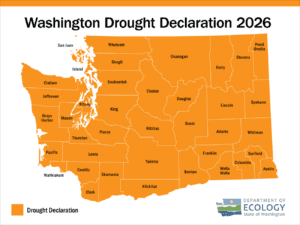
On April 8 2026, The Washington Department of Ecology declared a statewide drought emergency. This is the fourth year in a row that at least a portion of Washington State has been in a drought emergency.
That precipitation pattern was actually normal. Too much of it just fell as rain instead of snow, well before summer when demand peaks. Ecology says these “snow droughts” hit about one in five years in the 1990s. Today, they happen about 40% of the time, and research projects seven out of every 10 years by the 2050s.
“When I’m working on projects in Seattle, we think that there’s just this abundance of water and we’re known for our rain events, but our summers are so dry and we can go three months without a drop of water.”
Rachael Meyer Landscape Principal and Director of Sustainability, Weber Thompson
The pressure shows up on the wastewater side, too. To handle the pressure on sewer infrastructure, King County’s wholesale sewer rate is rising 12.75% in 2027 to $70.65 a month, with double-digit increases forecast for years to come. Every gallon a building owner recycles onsite is a gallon they don’t have to pay to send down the pipe.
State policy has been moving in the same direction. Until now, teams relied on the plumbing code and case-by-case local approvals, with no statewide treatment standard. In 2021, the Legislature passed H.B. 1184, directing DOH to create risk-based standards for non-potable reuse in commercial and multifamily buildings to cover the state’s side of the policy gap. After five years of drafting, comment periods, and a public hearing, those standards are now final.
What it means for your projects
The biggest change is state-level certainty with a clearly defined regulatory pathway. With statewide standards in place, teams can scope treatment, costs, and timelines with much more confidence from the first design meeting.
The state has established the DOH as the default regulator, but local health jurisdictions can take on some or all oversight if they establish a joint plan of responsibility, and you’ll still need local building and plumbing permits. Requirements can vary by city and county, so it pays to start those conversations early. Build in time for startup, too. Biological treatment systems take a month to become fully established and new systems will need to run for 12 months in conditional startup mode before they get an operating permit, which can affect occupancy plans and water savings projections.
Design your end uses around what’s allowed from the start. Treated water from any source, including rainwater, can’t be used for drinking, cooking, showering, handwashing, bidets, patio misting, or irrigating edible plants. And if you already own a system built or permitted before the rule took effect, you’ll need to submit an engineering report to the DOH and, likely, your local jurisdictions having authority showing you comply with the new rule by June 1, 2028.
More from our recent webinar
In October, we brought together experts in green building certification, landscape architecture, sustainability consulting, and water policy for a panel on the full picture of water reuse. One theme kept coming up: in more and more places, reuse is moving from a sustainability bonus to part of how projects get approved.
“The question is moving from ‘how much water can we save’ to ‘can this project exist at all and add demand responsibly?'”
Sam Mitchell Senior Sustainability Manager, VCA Green
Watch our recent webinar recording to learn more about The Full Picture of Water Reuse and hear perspectives from a panel of experts in green building certification, landscape architecture, sustainability consulting, and water policy.
FAQs
Does the rule apply to my project?
It applies to commercial buildings (including multifamily buildings with five or more units), mixed-use buildings, multifamily residential buildings, and district-scale projects. It does not apply to single-family homes, industrial reuse, closed-loop systems like laundry recycling, rainwater systems with only outdoor uses that do not irrigate edible plants, small greywater irrigation systems under Chapter 246-274 WAC, or reclaimed water facilities permitted by the Department of Ecology.
What does the permitting process look like?
New systems follow a step-by-step approval path at the state level, with sign-off required before moving to each step. Note that additional steps will likely be required by your local agencies.
Optional pre-project meeting with the regulator
Feasibility study, including a list of all local permits affecting the project
Engineering report stamped by a Washington-licensed professional engineer
Construction documents and copies of all issued local building and plumbing permits
Written approval to construct, followed by construction and inspections
Construction completion report, record drawings, and facility inventory within 60 days, plus a cross-connection test witnessed by the local authority
12-month conditional startup mode final report, monthly reporting, and O&M manual
Operating permit submission which is renewed annually
DOH review times aren’t published, so starting early is the best way to protect your schedule.
What does it cost?
Washington State DOH design review fees are $1,548 for a minor project or $3,096 for a major project, plus $387 per hour beyond the included review time. The annual operating permit is $2,572. Local health or other jurisdictions overseeing a project may charge their own fees.
Who actually regulates my system?
It depends: DOH by default, but a local health jurisdiction can collaborate on or over some or all of the work through a joint plan of responsibility with DOH. Your local building and plumbing departments also stay involved, issuing permits, inspecting during construction, and witnessing cross-connection testing.
I already have a system. What do I need to do?
Systems operating before January 1, 2022, or designed, permitted, or operating before the rule took effect, must submit an engineering report by June 1, 2028. The report describes the existing system and any changes needed to comply. Owners can apply for a waiver of up to three years if compliance would be cost prohibitive.
Ready to build in Washington?
Washington’s new rule opens the door for more buildings to recycle water onsite, and the teams that plan early will move fastest. Epic Cleantec supports projects from feasibility through permitting, startup, and long-term operations. Reach out to talk through your next Washington project with us.
Privacy Notice: This website uses cookies to learn how visitors interact with our site so that we can improve your online experience and our services. By using this website, you agree to our privacy policy.


 “When I’m working on projects in Seattle, we think that there’s just this abundance of water and we’re known for our rain events, but our summers are so dry and we can go three months without a drop of water.”
 “The question is moving from ‘how much water can we save’ to ‘can this project exist at all and add demand responsibly?'”