8 FIFA World Cup host cities are running low on water. What’s the tournament’s water footprint?

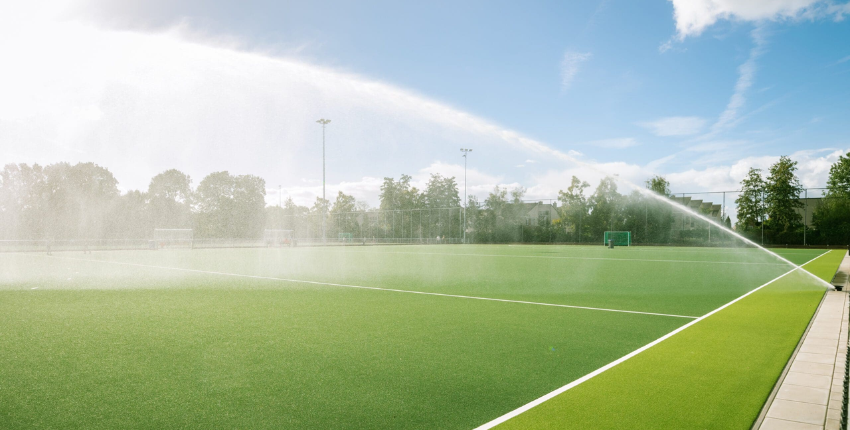
The FIFA World Cup 2026 has arrived in North America, and with it comes an unprecedented test of our water infrastructure. The 48-team tournament spans 104 matches across 16 host cities in Canada, Mexico, and the United States, drawing millions of visitors over the course of a month.
In water terms, this isn’t just another big sporting event. Unlike a single Super Bowl at a single venue, the World Cup will stress water systems from Vancouver to Miami, from Seattle to Boston, all at once. See our breakdown of how much water the Super Bowl uses.
Here’s what the water picture actually looks like and what the best-prepared venues are doing about it.
A tournament spread across a water-stressed continent
The 16 host venues span three countries and dramatically different climates. In the United States alone, matches will be played at Levi’s Stadium in Santa Clara, Lumen Field in Seattle, SoFi Stadium in Los Angeles, Arrowhead Stadium in Kansas City, NRG Stadium in Houston, AT&T Stadium in Dallas, Mercedes-Benz Stadium in Atlanta, Hard Rock Stadium in Miami, Gillette Stadium near Boston, Lincoln Financial Field in Philadelphia, and MetLife Stadium in New Jersey.
The numbers tell a sobering story. According to Pitches in Peril, the first global climate risk report for soccer, eight of the eleven U.S. host venues face water stress severe enough to pose a risk of event disruption, meaning irrigation water availability is increasingly uncertain. In practical terms, that raises the risk of usage restrictions, higher water costs, or operational strain during the competition itself.

But the report goes further than that headline number. It finds that 14 of the 16 World Cup stadiums already exceed safe-play thresholds for at least three major climate hazards, including extreme heat, unplayable rainfall, and flooding. And those risks intensify at every single venue by 2050.
And that’s before accounting for the sheer volume of water consumed by each match.
How much water does a stadium actually use?
Soccer stadiums consume hundreds of thousands of gallons of water per event, spread across four main categories: pitch irrigation, spectator restrooms, food and beverage service, and HVAC systems. Each category carries a surprisingly large footprint.
Irrigation
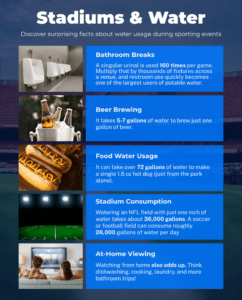
A soccer or football field can consume roughly 26,000 gallons of water per day to maintain healthy turf, according to the Economic Times. For high-stakes matches where pitch conditions are closely scrutinized, there’s no cutting corners on irrigation, especially in hot, arid climates like Los Angeles or Dallas.
Restrooms
The average stadium urinal is used 160 times during the course of one game and can consume up to 40,000 gallons of water per year. Multiply that by thousands of fixtures across a venue, and restroom use quickly becomes one of the largest sources of potable water demand at any major sporting event.
Food, Beverage, and Concessions
Producing and serving food and drinks at scale is also heavily water-intensive. It takes an estimated 5–7 gallons of water to produce just one gallon of beer. Hot dogs, a stadium staple, require more than 70 gallons of water each to produce. Across a tournament of 104 matches with sellout crowds, those numbers add up fast.
It’s worth noting that FIFA recently reversed its initial decision to bar fans from bringing refillable water bottles into stadiums, following fierce backlash from fans and politicians. With temperatures of 90°F and above expected across many host cities, access to water inside the stadium is a genuine public health concern, not just a comfort issue.
HVAC and Cooling
Climate control systems in large enclosed or semi-enclosed stadiums, particularly in hot and humid cities like Miami, Houston, and Dallas, consume substantial quantities of water for cooling tower operations and evaporative systems. This is no small concern: as temperatures rise, so does the demand for cooling water.
Levi’s Stadium: a model for water sustainability
Among the 2026 host venues, Levi’s Stadium in Santa Clara stands out as one of the most advanced in terms of water conservation. Levi’s Stadium was the first NFL stadium to achieve LEED Gold certification. The venue was designed from the ground up with sustainability in mind, including a dual-plumbing system for both potable and recycled water, a bio-filtration system, a large green roof, and an on-site vegetable garden.
The results are striking. According to Roger Elu, Levi’s Stadium Chief Engineer:
“Since opening in 2014, Levi’s Stadium has used about 120 million gallons of recycled water for irrigation, restrooms, and other uses — enough to fill the entire stadium with water and more.”
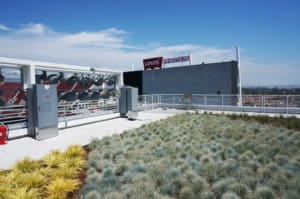
Levi’s facility includes a bio-filtration system, a large green roof, an on-site vegetable farm, solar power generators, and more.
Approximately 85% of the water used at Levi’s Stadium is recycled water, supplied by the Santa Clara Valley Water District and used for field irrigation, toilet flushing, cooling systems, and the stadium’s green roof.
Low-flow fixtures throughout the stadium consume 40% less water than traditional alternatives. Pressure-washing systems use roughly 3,000 gallons per hour, a reduction of more than 75% compared to the 16,000 gallons per hour previously required for cleaning.
Elu emphasizes that the stadium’s systems are built for exactly these high-demand moments:
“Levi’s Stadium follows the same water conservation strategies for all world-class events. The stadium’s infrastructure is designed to handle increased demand without sacrificing sustainability.”
Other stadiums investing in water conservation
Levi’s Stadium isn’t alone. Across the country, the 2026 host venues have widely invested in water conservation, from decades-long sustainability programs to recent infrastructure overhauls:
- Gillette Stadium invested in onsite water infrastructure to reduce its dependence on the municipal potable water supply. The stadium recycles about 46 million gallons of greywater and wastewater annually, saving approximately 250,000 gallons on game days. This reclaimed water is primarily redirected to flush thousands of toilets and provide non-potable water throughout the stadium complex and the adjacent Patriot Place development.
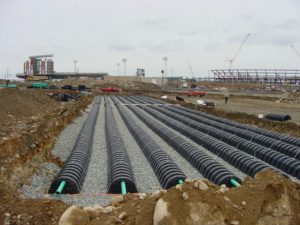
The Gillette wastewater treatment plant is now the largest water reuse facility in Massachusetts
- MetLife Stadium deployed a comprehensive set of water conservation measures: waterless urinals in men’s rooms save 2.7 million gallons of water annually, while sensor faucets, low-flow showerheads, and low-flush toilets drive further reductions throughout the venue. Planting native species with a high-efficiency irrigation system saves 700,000 gallons per year, and using decomposed granite for landscaping medians saves another million gallons. Switching to synthetic turf saves 3.5 million gallons per year compared to natural grass. .

Falcon CEO James Krug in a Los Angeles Coliseum men’s room with the company’s waterless urinals.
- Lincoln Financial Field installed simultaneous-flush urinals in 2023, saving more than 5,000 gallons of water per event. Urinal water use was also reduced from one gallon to half a gallon per flush; more efficient aerators were installed throughout; and two rain gardens were built in partnership with the Philadelphia Water Department to offset stormwater runoff.
- Lumen Field installed low-flow water fixtures throughout the venue, resulting in a 1.3 million gallon reduction in annual water use. The stadium’s sustainability commitments explicitly include water conservation alongside energy reduction and zero-waste operations.
- NRG Stadium partnered with Johnson Controls on a landmark energy savings performance contract targeting $54 million in savings and a 40% reduction in carbon emissions by 2030. Upgrades span the entire 350-acre NRG Park complex and include HVAC equipment, building automation systems, water conservation systems, life safety systems, LED lighting retrofits, and high-efficiency chiller upgrades.
The climate risk breakdown
The Pitches in Peril report provides a granular risk assessment for each of the host stadiums, scoring them on heat, drought, flooding, and extreme weather. The findings paint a stark picture of how unevenly climate risk is distributed across the tournament and how water stress specifically threatens operations.
New Jersey — MetLife Stadium: Scored a maximum 10/10 on water stress, reflecting persistent conditions where local water demand exceeds supply tenfold. On top of that, the stadium faces some of the tournament’s most serious flood risk; modeled flood depths on the pitch could reach 3’ 9” during a major storm event, with surrounding areas reaching nearly 5’ 7”.
Dallas — AT&T Stadium: By 2050, water demand is projected to exceed supply by 50%. The stadium also faces 123 days per year of heat requiring adaptation (up from 98 in 2025), and 64 days per year of conditions too dangerous to play outdoors at all. Flood depths around the stadium could reach 4’ 3”.

Los Angeles — SoFi Stadium: Already faces severe drought stress, with water demand projected to exceed supply more than fivefold by 2050. The January 2025 Los Angeles wildfires, which displaced over 100,000 people and destroyed more than 16,000 structures, were a direct preview of the compounding risks facing this venue.
Houston — NRG Stadium: Houston is projected to face some of the most intense heat exposure of any host city. 128 days per year currently exceed the 88°F WBGT safety threshold, rising to 152 days (42% of the calendar year) by 2050. In July 2024, Hurricane Beryl tore panels from the stadium roof.
Miami — Hard Rock Stadium: By 2050, Miami will face 164 days with WBGT exceeding 88°F and 54 days with conditions beyond football’s safe limits. During the 2024 Copa América match at this venue, Uruguay defender Ronald Araújo was substituted at halftime due to heat-related dehydration.
Kansas City — Arrowhead Stadium: Already a proven heat flashpoint. During the 2024 Copa América match between Peru and Canada at this venue, assistant referee Humberto Panjoj collapsed from heat stress on the field. The heat index that day had surpassed 100°F. By 2050, the stadium faces 72 days per year of extreme heat and 33 days of unplayable conditions.

Levi’s Stadium, San Francisco Bay Area: Water stress is currently a modest 0.2 and only rises to 0.3 by 2050. Heat risk is minimal. This relative climate stability is one more reason Levi’s commitment to water reuse is a model worth highlighting.
The Pitches in Peril report also includes a striking forward-looking warning: this could be the last World Cup of its kind in this region. Without significant adaptation, it’s unlikely that future tournaments in North America will follow the same model. Climate risks may demand a very different approach to when, where, and how matches are played.
What past World Cups have done
The FIFA World Cup Qatar 2022 set a new benchmark for stadium sustainability. All eight stadium designs were assessed under the Global Sustainability Assessment System (GSAS), with water efficiency as a primary category. Six of the eight stadiums received GSAS Operations certification. The full FIFA Qatar 2022 sustainability report and GSAS Energy & Water Performance Report detail how those venues performed.
The FIFA World Cup 2026 aims to match and exceed that standard. As the tournament opens, 13 of the 16 host stadiums have already earned LEED certification, according to the U.S. Green Building Council. Together, those certified venues are projected to save over 100 million gallons of potable water annually and eliminate more than 5 million single-use plastics per year.
What the World Cup teaches us about water resilience
By 2050, nearly 90% of World Cup host stadiums are projected to face extreme heat conditions unsafe without adaptation, and 11 of 16 will experience conditions where matches simply cannot be safely staged.
The stadiums taking sustainability seriously are showing what’s possible. Dual-plumbing systems, smart-sensor irrigation, low-flow fixtures, rainwater harvesting, and onsite wastewater recycling aren’t just environmental gestures. They’re operational necessities as water becomes scarcer and more expensive.
The World Cup will come and go. The water challenges it highlights will not. Stadiums and large venues that invest in onsite reuse now will be far better positioned financially, operationally, and reputationally.
Want to learn more about onsite water reuse for large venues and developments? Contact Epic Cleantec to start the conversation.
Related reading: The Super Bowl Uses More Water Than You Think | Levi’s Stadium: A Water Reuse Leader