SB 966: An owner’s guide to California’s onsite water reuse regulations


California’s approach to onsite water reuse has entered a new chapter. With statewide regulations for onsite treated non-potable water systems now in place, building owners, developers, and design teams have a clearer framework for designing, permitting, and operating these systems.
Here’s what you need to know about SB 966, how it may affect new and existing projects, and what to consider as local jurisdictions begin implementing the new requirements.
What Is SB 966?
SB 966 is a California law, signed in 2018, that directed the State Water Resources Control Board (State Water Board) to write statewide rules for onsite treated non-potable water systems (OTNWS). These are building- or community-scale systems that collect greywater, rainwater, stormwater, or blackwater and treat it onsite for reuse in toilet and urinal flushing, irrigation, laundry, and similar non-potable purposes.
See the full bill text and the original bill announcement from Senator Scott Wiener’s office.
The State Water Board adopted the resulting regulations on November 19, 2025, developed with an expert panel convened by the National Water Research Institute (NWRI). Instead of one treatment recipe for every building, SB 966 required the state to publish a menu of prescriptive “treatment trains” (specific combinations of filtration, disinfection, and monitoring) calibrated to each source-water/end-use pairing. That way, an owner or engineer can select a pre-validated system rather than commission custom risk modeling for every project.
See the State Water Board’s Initial Statement of Reasons for the regulations for the technical detail.
How will it affect current and future projects?
SB 966 does not force any building to install a reuse system. It enables local jurisdictions (cities and counties) to opt in by adopting, through ordinance, a local program that incorporates the state’s risk-based standards. See the bill text for the local-program requirements.
- Future projects: any new OTNWS must be designed to the treatment train and log-reduction targets in the state regulations. See more details below.
- Current (“legacy”) systems: existing systems already in operation are not grandfathered in. Per the bill text, they must come into compliance by April 21, 2028. If the owner is actively working toward compliance but faces engineering, repair, or replacement constraints, a local jurisdiction may extend that deadline to April 21, 2031.
- Relationship to existing rules: these regulations complement—rather than replace—the existing Title 22 recycled-water (“purple pipe”) rules that govern larger, municipal-scale recycled water, described in the EPA’s summary of California’s onsite non-potable water reuse regulation.
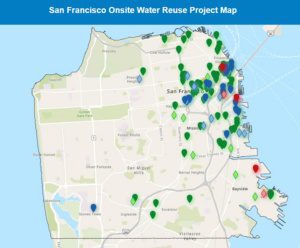
Under SFPUC’s Onsite Water Reuse Program, there are 50+ completed onsite water reuse systems, including blackwater, graywater, rainwater, stormwater, condensate systems, and more.
View the full map of onsite water reuse systems in San Francisco here.
How will I know if my existing/proposed system complies?
Once a local jurisdiction adopts an OTNWS program, that jurisdiction becomes the permitting and enforcement authority. In practice, owners will work with their engineer and the local AHJ agency to:
- Identify the system’s source water(s) (greywater, rainwater, stormwater, blackwater) and intended end use(s).
- Compare the current or proposed treatment train against the prescribed treatment train requirements. Additionally, ensure pathogen log-reduction targets are met for the specific source/end-use combination.
- Obtain sign-off through the local jurisdiction’s permitting and cross-connection-control review.
- For existing systems: proactively contact the local jurisdiction’s environmental health or building department to determine compliance status and any required upgrades within the compliance window described in Section 5.
Local jurisdictions must also file an annual report to the State Water Board summarizing violations and corrective actions in their program, so a compliance record exists at the jurisdiction level (per the bill text).
⚠️ Important caveat: because statewide adoption of the regulations occurred only in 2026, many cities and counties have not yet established their own OTNWS programs. Owners should first confirm whether their city or county has adopted a program at all before assuming SB 966 permitting applies to their project today.
Contact Epic Cleantec if you have any questions on this bill, or would like to understand if your system is in compliance with these new regulations.
What happens if systems don’t comply?
Onsite recycled water is administered under Chapter 3.5 of California Title 22. That subchapter doesn’t spell out civil penalties on its own; enforcement instead draws on the general toolkit used across California water programs (Chapter 3 of the Water Code), giving the State Water Board and local jurisdictions a graduated set of options that escalate only if issues go unaddressed: cease and desist orders (Water Code §§13301, 1831), cleanup and abatement orders (Water Code §13304), Administrative Civil Liability, or ACL (Water Code §§13350, 13385, 13399.30, as applicable), and, in more serious cases, permit modification, suspension, or revocation under the Porter-Cologne Water Quality Control Act.
The figures below are statutory ceilings, not typical outcomes, and generally apply only after notice and a chance to correct the issue:
- Health and Safety Code §116665: up to $1,000 per day, per violation
- Health and Safety Code §116730: up to $25,000 per day, reserved for knowing (willful) violations
- Local jurisdiction ordinance penalties, which vary by jurisdiction
- Water Code §13385: mandatory minimums of $3,000 per “serious violation.” This is the most common exposure for OTNWS, largely a paperwork issue, since it applies when required reports or monitoring data aren’t filed, and it’s avoidable by staying current on routine reporting.
Locally, jurisdictions may layer on their own measures. San Francisco, for instance, charges 3x the normal water rate for excess use, a usage-based incentive to keep a system running rather than a punitive fine.
None of this is designed to catch owners off guard: penalties could technically apply once a system is enrolled, but legal and procedural realities mean enforcement lags. Local jurisdictions are still finalizing their enrollment processes, so the practical compliance clock starts once those are defined, with a reasonable window for owners to get up to speed.
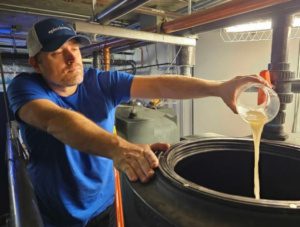
Epic Cleantec provides certified operators with deep water reuse operations and maintenance experience for both conventional systems as well as high-tech systems (MBR, RO, UV disinfection, SCADA-controlled).
Timeline for ensuring compliance
Existing OTNWS systems in operation before April 22, 2026 must comply with Chapter 3.5 requirements by April 21, 2028 (§60608). If a local jurisdiction finds the project proponent is working toward compliance but extenuating circumstances tied to engineering, repair, or replacement of the OTNWS warrant more time, the jurisdiction may extend that deadline to April 21, 2031.
- New systems: the compliance clock starts when the system goes online.
- Local jurisdictions still need to adopt their own ordinances and programs before OTNWS permitting can begin locally, so the practical applicability date will vary by city and county.
Why is this regulation relevant, and what does it mean for the future of water reuse?
California created SB 966 against a backdrop of recurring drought and rising demand on limited potable supplies. Standardizing risk-based pathogen targets statewide, rather than leaving each city to invent its own criteria, lowers the cost and uncertainty of permitting onsite reuse, which should accelerate adoption in new construction, especially multifamily, commercial, and mixed-use buildings.
SB 966 also formalizes and complements city-level mandates already in place, such as San Francisco’s Article 12C, which already requires onsite reuse in large new developments. In effect, it moves building-scale water reuse from a handful of pioneering cities toward a standardized, statewide framework: a signal to owners, developers, and the design and engineering community that onsite reuse is becoming a mainstream, code-recognized building system rather than a novel pilot.
Risk-based log reduction targets in plain terms: regulators worked backward from an acceptable level of health risk to figure out how much pathogen (enteric virus, bacteria, or protozoa parasite) has to be removed or inactivated for each combination of source water and end use. A log reduction is simply a tenfold cut in pathogen concentration: 1-log means 90% removed, 2-log means 99%, 4-log means 99.99%, and so on.
How do you confirm your system is SB 966 compliant?
Before assuming your system is covered (or exempt), it’s worth running through a quick self-assessment. The checklist and decision tree below are a starting point, not a substitute for a formal review by your local jurisdiction.
Compliance checklist
- Confirm jurisdiction status: check whether your city or county has adopted an OTNWS program established under SB 966 guidelines.
- Identify source water(s): greywater, rainwater, stormwater, or blackwater; note every source your system uses or will use.
- Identify end use(s): toilet/urinal flushing, irrigation, laundry, cooling, or other non-potable uses.
- Match to the state’s treatment train: find the prescribed pathogen log-reduction target and treatment train for your specific source-water/end-use pairing in the adopted regulations. As a reminder, greywater and blackwater systems must be Membrane Bioreactor (MBR) type systems.
- Compare against your actual system: check whether your filtration, disinfection, and monitoring setup meets or exceeds that benchmark.
- Check your compliance deadline: for existing (“legacy”) systems, confirm where you stand ahead of the April 21, 2028 deadline (extendable to April 21, 2031 with jurisdiction approval).
- Confirm permitting sign-off: verify your system has, or is in process of obtaining, local permitting and cross-connection-control approval.
- Review reporting obligations: check whether your jurisdiction requires ongoing monitoring, recordkeeping, or violation reporting, and confirm your O&M plan covers it.
- Revisit periodically: many jurisdictions are still standing up their programs, so requirements may shift as local ordinances are adopted.
Quick decision tree
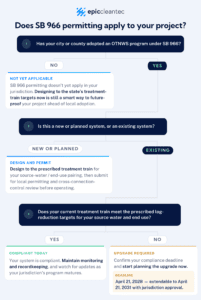
Need help? Contact Epic Cleantec for a no obligation review of your system.
Do you see other cities or states implementing similar policies?
Yes, momentum has been building across the country for several years, not just in California:
- San Francisco, CA (Article 12C): new developments of 100,000+ gross square feet must install and operate an onsite water reuse system (SFPUC).
- Los Angeles, CA (Green Building Code): cooling-tower non-potable water mandates and a 20% potable-use reduction requirement for new large buildings (LADBS).
- Austin, TX (GoPurple): new commercial, multifamily, and mixed-use projects of 250,000+ square feet must reuse water onsite or connect to the city’s purple-pipe system, effective April 2024 (Austin Water).
- Colorado (HB24-1362): authorizes statewide greywater treatment and reuse in new construction, effective January 1, 2026 (Colorado General Assembly).
- Washington (HB 1184, 2021): directs development of statewide, risk-based non-potable reuse standards for commercial and multifamily buildings, the same regulatory model as SB 966 (Washington State Legislature).
- Virginia: new rainwater-harvesting system regulations took effect in November 2024 (Virginia Dept. of Health).
- New York City: offers a water conservation and reuse grants program, including utility-fee reductions for buildings that cut water use through onsite reuse (NYC DEP).
- Federal level: the proposed Advancing Water Reuse Act (H.R. 2940) would create the first federal tax credit specifically for industrial and commercial water reuse.
For a continuously updated, state-by-state breakdown of onsite reuse regulations, see Epic Cleantec’s Onsite Water Reuse Regulations by State tracker.
Need help with SB 966 compliance?
Every jurisdiction’s rollout looks a little different, and getting the treatment train right the first time avoids costly retrofits later. Epic Cleantec’s engineering team can evaluate your source water and end-use mix, check where you stand against the state’s log-reduction targets, and help you navigate local permitting. Contact Epic Cleantec’s team with questions, or request a free project assessment to get started.