Looking at water’s role in digital infrastructure

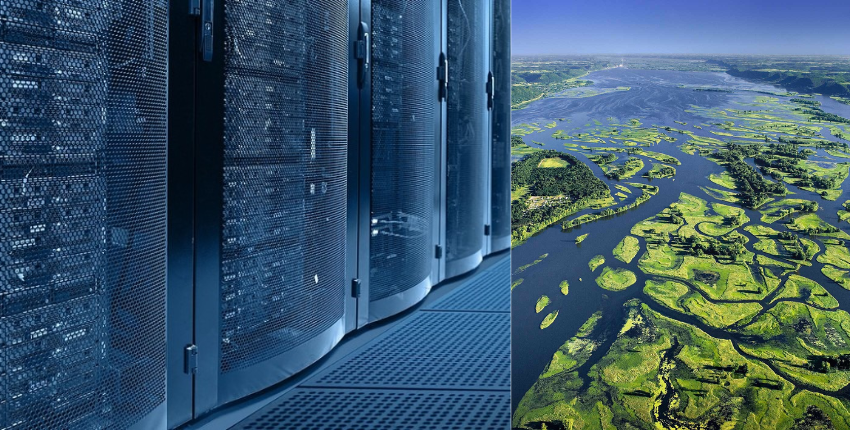
The conversation around the footprint of data centers has mainly focused on energy. The scale of the power required to support this growth is immense, and the people working to expand grid capacity, accelerate clean generation, and improve efficiency are addressing one of the defining infrastructure challenges of our time.
But over the past couple of years, the focus has shifted. Water has become a more prominent talking point. It’s no longer just utilities and sustainability teams talking about water. In fact, water is now the single most-cited reason communities give for opposing new data centers, appearing in more than 40% of contested projects nationally, and project cancellations tied to that opposition quadrupled from 2024 to 2025.
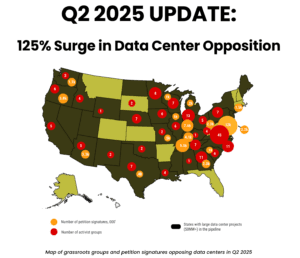
Map of grassroots groups and petition signatures opposing data centers in Q2 2025
Communities are already feeling stretched
Most communities weighing a new data center aren’t starting from a place of abundance. U.S. data centers directly consumed an estimated 17.4 billion gallons of water in 2023, and Lawrence Berkeley National Laboratory projects that figure could climb to as much as 73 billion gallons by 2028 as AI-driven demand accelerates. Layer that onto aquifers already drawn down and utilities balancing competing demand.
In early 2026, San Marcos, Texas, city council voted 5-2 to block a proposed data center after residents raised concerns about a stressed Edwards Aquifer, one of a growing number of communities asking the same thing: what happens to the water we depend on?
View this post on Instagram
How material is water usage in digital infrastructure?
It’s important to note that data centers are rarely the largest line item on a city’s water budget. In 2023, U.S. data centers directly consumed 17.4 billion gallons of water for cooling, plus another 211 billion gallons indirectly through the electricity that powers them. Together, that’s under 0.2% of the roughly 118 trillion gallons the country withdraws annually for all uses.
But that snapshot doesn’t show the full trend. Data center water use is growing faster than almost any other major water-use category. One analysis projects a 170% jump in U.S. data center water consumption by 2030. Agriculture and power generation aren’t shrinking, but they’re not compounding like that either.
Public pressure to simply “stop using water” carries its own risk: pushing facilities toward refrigerant-based cooling instead. That’s not automatically a safer trade. Many refrigerants still in use carry global warming potentials in the thousands, and even small leaks add up to real emissions over a facility’s lifetime. Regulators are only now moving to require low-GWP alternatives by 2027. Systems built without a real decommissioning plan carry their own risks to long-term reliability and end-of-life handling.
Data centers are newcomers to the fight over water rights in the U.S. But as companies rush to build and operate them, data centers have become a scapegoat for a much older problem: our aging, failing water infrastructure. In many communities, a data center’s water use gets dismissed as a “nice to have” tacked onto a budget that’s already draining the local aquifer.
The more useful conversation–once regulators and residents understand how this infrastructure actually works–isn’t water use versus no water use. It’s which kind of water, and where it comes from.
Offsetting the water usage
The best building water infrastructure is one that creates benefits beyond the building itself by giving back to the surrounding watershed.
A watershed is the area of land where all the water–rain, runoff, wastewater–is directed to the same rivers, lakes, or aquifer in that community. Every building, street, and yard in that area is connected through the water that flows beneath and around it. Water reused within a watershed stays in that same shared system, supporting the same rivers and groundwater it came from.
What offsetting looks like in practice is capturing the wastewater already being generated by nearby homes, offices, hotels, and multifamily buildings, then treating it onsite rather than sending it to a large treatment facility miles away just for it to end up in the watershed.
The result is a clean and local water supply for cooling towers, irrigation, toilet flushing, clothes washing, and other non-potable applications. Every gallon reused is a gallon that doesn’t have to be drawn from the community’s shared potable supply. Because the water is sourced and treated locally, it reduces demand on centralized infrastructure while creating a more resilient water system.
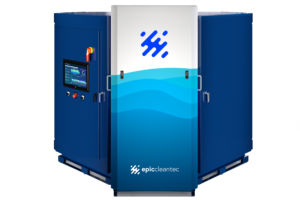
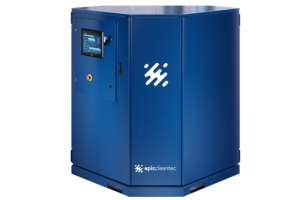
The OneWaterTM and OneWaterTM Rain systems can be used to capture and treat water in the same watershed.
This tactic shifts the conversation from “how much water will this facility consume?” to “how much water is this facility returning to the community around it?” It’s not simply a data center’s water plan. It’s a community water resilience strategy, one that strengthens local infrastructure and supports surrounding development.
Seeing is believing
This isn’t theoretical, and it isn’t limited to data center campuses. Google’s data center in Douglas County, Georgia draws treated effluent (recycled water) that would otherwise flow into the Chattahoochee River; a process known as indirect potable reuse. Instead, the facility only draws 13.2 million gallons of potable water per year out of the 422 million gallons consumed at the site.
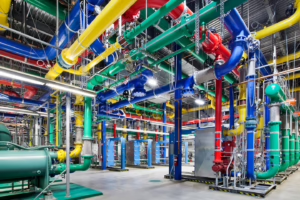
Multi-color pipes transport water around Google’s data center in The Dalles to cool equipment.
Microsoft helped build a water reuse utility in Quincy, Washington that cuts potable water use by 97% as part of its broader water positivity commitment. And in Virginia, AWS worked with Loudoun Water to become the first data center operator approved to use reclaimed water with direct evaporative cooling, an approach that uses up to 85% less water than conventional cooling.
The common thread isn’t the technology. It’s the sequencing: start with what the watershed needs to stay in balance, then build growth on top of that foundation, rather than the other way around.
Why this matters
Instead of wondering how to secure enough water for this facility, the conversation can turn to making sure the community and the ecology around it are better off because of the infrastructure getting built.
The energy conversation is being solved by people who treat grid capacity as a shared problem rather than a private one. Water deserves the same treatment. Not just a story about how much a singular facility needs, but a plan for how the watershed it lives in can come out ahead.
Curious how the next generation of data centers can reduce water risk while supporting rapid AI growth? Download our free 3-page guide.