Water and sewer costs are rising faster than inflation. Here’s what property owners can do.

Across the United States, municipalities are pushing through some of the steepest, most aggressive multi-year utility rate increases in modern memory, even outpacing inflation in certain cases. Rates have been skyrocketing across major cities like San Francisco, Los Angeles, Honolulu, Baltimore, Seattle, San Diego, Chicago, New York, Nashville, and more.
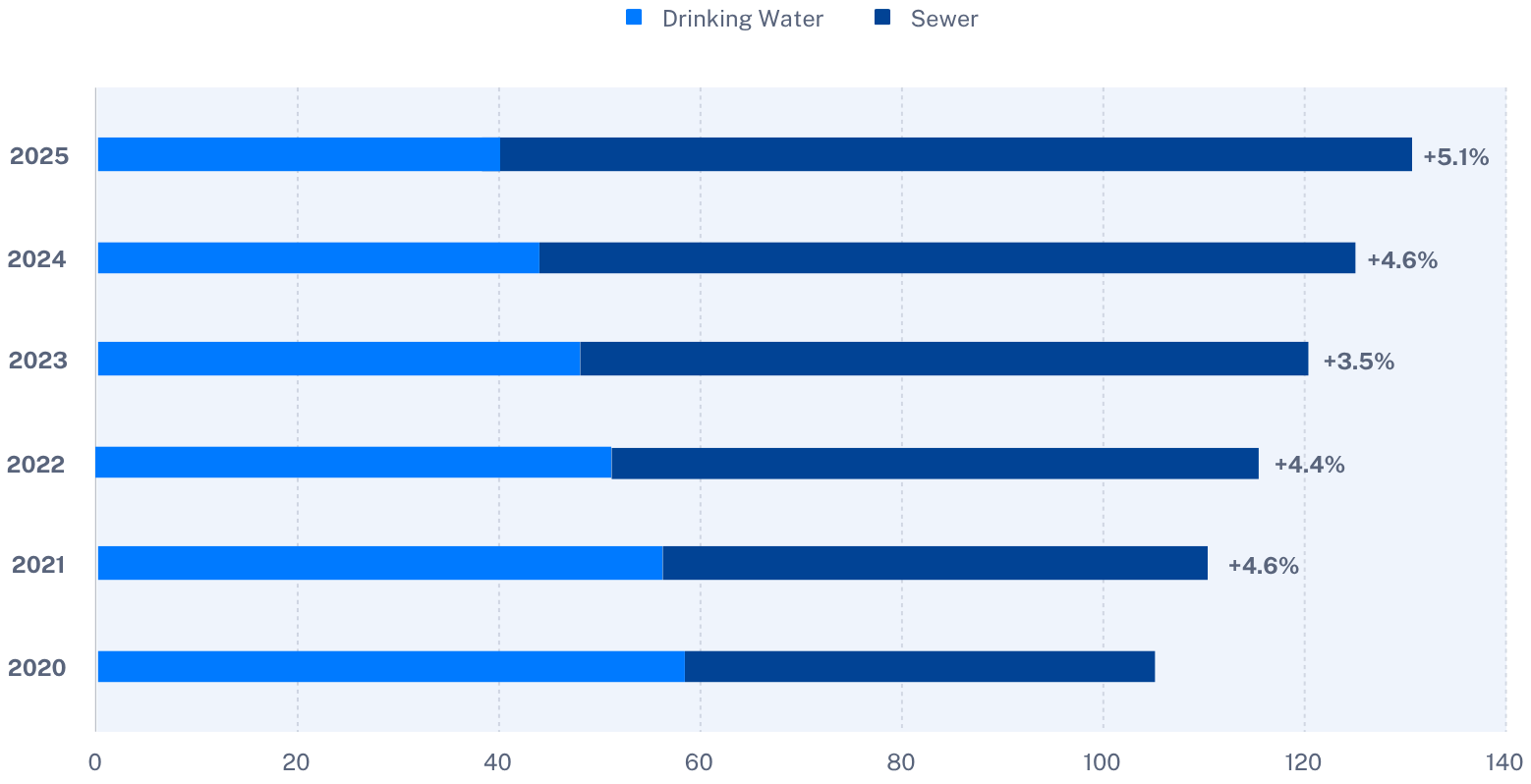
Household Water and Sewer Bills for 50 U.S. Cities, 2020–2025 (Source: Bluefield Research)
For building owners and developers, these escalating costs can directly erode Net Operating Income (NOI), an important metric for determining property value, debt service coverage, and investor returns. Unlike rent increases, which are subject to market constraints and regulatory limitations, utility cost increases are imposed unilaterally by municipalities and typically offer no mechanism for negotiation or relief.
Why are sewer rates changing?
Water and sewer utilities are almost entirely self-funded. San Francisco’s PUC puts it plainly: their work is “almost exclusively funded by the rates that customers pay, not by taxes.” They do not run on tax dollars; they run on what customers pay. So when infrastructure breaks down faster than it gets repaired–and right now that is exactly what is happening–the only lever the utility has is the bill.
The United States’ wastewater infrastructure is failing. The American Society of Civil Engineers gave U.S. wastewater systems a D+ in its 2025 report card, unchanged from 2021. Nearly 17,500 treatment plants nationwide are at or past their 40-to-50-year design lives, and the sector’s renewal and replacement rate for large capital projects has actually dropped from 3% to 2% over the last decade, even as collection system failures climbed from 2 to 3.3 per 100 miles of pipe. The annual funding gap for wastewater capital is about $69 billion, meaning we currently fund roughly 30% of what we need. By 2044, the cumulative shortfall is projected to exceed $690 billion.

None of that goes away with one good budget cycle. Which is why cities are no longer doing one-time rate corrections. They are locked into 5-year, 7-year, and 10-year escalator plans that are pre-scheduled, compounding, and politically painful to reverse. These are not adjustments. They are a permanent price hike in the building’s operating costs.
How are rising utility rates varying across the U.S.?
The shape of the reset varies across markets, but the trajectory is consistent. Los Angeles sewer charges are on track to roughly double by 2028. Honolulu sewer rates are climbing toward a 60% cumulative increase by 2031. San Francisco will see a 60% increase in water + sewer + stormwater rates by 2028. Baltimore will see a ~29% compounded rate increase by 2027. The list keeps growing.

And even if additional federal funding or policy intervention emerges, the scale of the nationwide infrastructure gap means these increases are unlikely to be unwound.
Below is a sample of confirmed sewer and wastewater rate increases already being implemented across major U.S. markets:
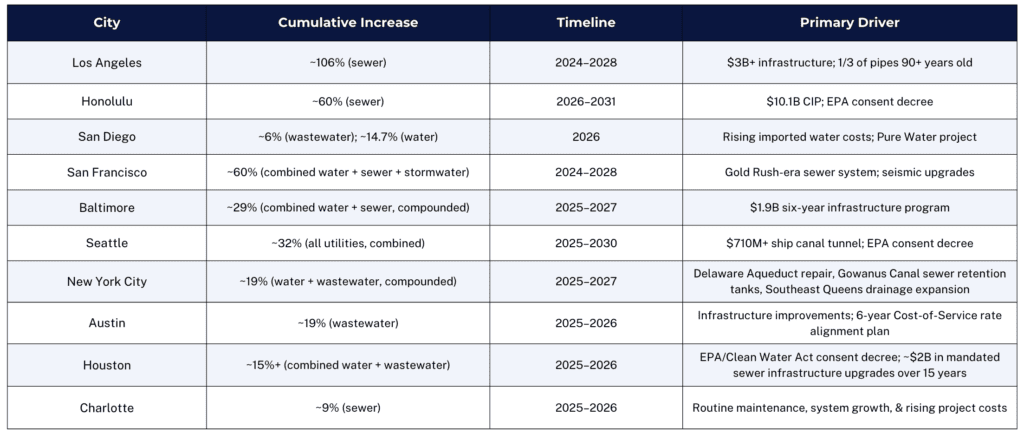 Sources: SFPUC FY27 to FY28 Rate Filing; Honolulu ENV Sewer Fee Rate Study; City of San Diego Public Utilities (effective Jan 1, 2026). Bill estimates will vary by usage, meter size, and jurisdiction.
Can rising utility rates decrease Net Operating Income?
The owner’s problem is not the bill. It is the cap rate. Here is where this stops being an operations question and becomes an asset-value question.
In commercial real estate, Net Operating Income (NOI) affects more than just cash flow. It sets the value of the asset itself. Using the capitalization rate formula (Property Value = NOI ÷ Cap Rate), every dollar increase in operating expenses quietly translates into a much larger dollar loss in property value.
Unlike management fees or maintenance contracts, water and sewer charges are not negotiable. They are not competitive. They are not optimizable. They are imposed by a municipal rate schedule, and they function, in effect, as a tax on your operations.
For a real estate owner evaluating a project with a 30-year useful life, today’s sewer rates are the lowest rates that the building will ever experience.
A 1,000-unit case study
To understand why water reuse offers a clear solution to the impact of rising sewer rates on NOI, consider a hypothetical 1,000-unit multifamily development in Los Angeles (like the forthcoming 787 S. Alameda Street).
Baseline assumptions
- 1,000 apartments; average 1.6 residents per unit; ~1,600 residents
- Indoor water use: 50–60 gallons per person per day (apartment, no outdoor irrigation)
- Total building water consumption: ~80,000–96,000 gallons per day
- Annual water consumption: ~29–35 million gallons per year
Apply LA’s approved sewer rate schedule, which assumes 93% of metered water returns to the sewer system. Under the LA Bureau of Sanitation’s approved Ordinance 188363 rate schedule, the sewer line item for this building roughly doubles between 2024 and 2028. That is a recurring annual expense increase of approximately $318,000 in sewer costs alone.
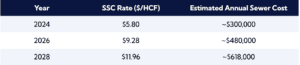 (*Estimated based on 5,500 HCF annual consumption at 93% return factor.)
This represents a $318,000 annual increase in sewer costs alone over four years, before accounting for rising water supply charges.
At a 5% cap rate, this increase in operating expenses translates to a $6.4 million reduction in property value by 2028, unless these costs are offset.
That $6.4 million is a direct, mechanical reduction in the building’s value because of an expense the owner cannot negotiate, reduce through operational discipline, or escape.
And the rate schedule that produced it only runs through 2028. The drivers behind it (aging infrastructure, EPA consent decrees, climate adaptation, construction inflation) are not expiring.
How can water reuse help protect against increasing rates?
Onsite water reuse, which recycles a building’s wastewater for non-potable uses like toilet flushing, irrigation, cooling tower makeup, and laundry, has been around long enough that the technology questions are largely settled. The interesting question now is not whether the technology works. It is what it does to a building’s financial profile.
In most multifamily buildings, non-potable uses account for 40-55% of total water demand. A system that captures and recycles that fraction generates savings on two sides of the meter simultaneously: water purchased and sewer discharged. Because sewer charges are calculated as a percentage of metered water, every recycled gallon is a gallon that does not generate a sewer bill.
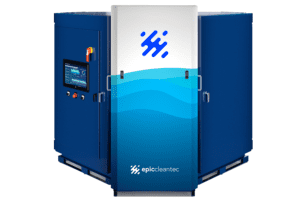

Epic Cleantec’s OneWaterTM Reuse System
By recycling a building’s wastewater for non-potable applications such as toilet flushing, irrigation, cooling, and laundry, systems like Epic Cleantec’s OneWaterTM can reduce a building’s water and sewer utility costs by up to 75%, generating hundreds of thousands of dollars in annual savings for large developments.
Beyond utility savings, onsite reuse also reduces dependency on increasingly stressed municipal water systems during droughts, restrictions, or infrastructure disruptions.
1,000-unit case study, but with Epic’s OneWaterTM reuse system
Returning to the case study, the same asset could increase in value by installing a water reuse system. Non-potable uses (toilet flushing, irrigation, cooling, laundry) typically represent 40–55% of total water demand in a multifamily building:

At a 5% cap rate, the building owner could expect an annual savings of $400,000. Hypothetically and excluding other variables, this translates to a conservative $8 million increase in property value, and this figure grows every year as rates continue to climb.
$6.4 + $8 = A $14.4 Million total value swing between “do nothing” and “install a system.”
As seen in the first case study above, the ~$318,000 annual increase in sewer costs for this project under LA’s rate schedule would reduce property value by approximately $6.4 million at a 5% cap rate. The water reuse system eliminates that loss entirely while generating an additional $8 million in value from net savings. The total value swing between scenarios is approximately $14.4 million, the sum of the $6.4 million in avoided value erosion and the $8 million in new value creation.
For developers and investors evaluating the ROI of onsite water reuse, this combined figure totals $14.4 million in additional value by 2028.
What can a building owner do about rising water and sewer costs?
The national sewer rate crisis is not speculative. It is not just a 2030 forecast. It is happening to buildings being underwritten right now, with rate schedules already approved and effective dates already on the calendar.
Owners and developers have two choices:
- The first is to absorb compounding municipal cost increases for the life of the asset, watch them grind down NOI year over year, and accept the cap-rate-multiplied erosion of property value that follows.
- The second is to install infrastructure that cuts that exposure by up to 90%, turns rising rates from a liability into a hedge, and grows in financial value as the rate environment worsens.

The luxury hotel, the Waldorf Astoria Beverly Hills, installed an Epic Cleantec OneWaterTM system in its building to reuse greywater onsite for irrigation.
Water rates are going up. The question is whether they are going up on your tenants’ bill, or whether your building has already opted out. For decades, water and sewer costs were treated as a fixed operating expense. Increasingly, they are becoming a controllable financial risk and one that will separate resilient buildings from exposed ones over the next decade.
Download the full white paper
To learn more about how onsite water reuse works and whether it is right for your project, visit Epic’s Onsite Water Reuse overview and Sustainable Water Infrastructure Solutions pages.