The state of water in Texas: challenges, innovation, and the rise of reuse

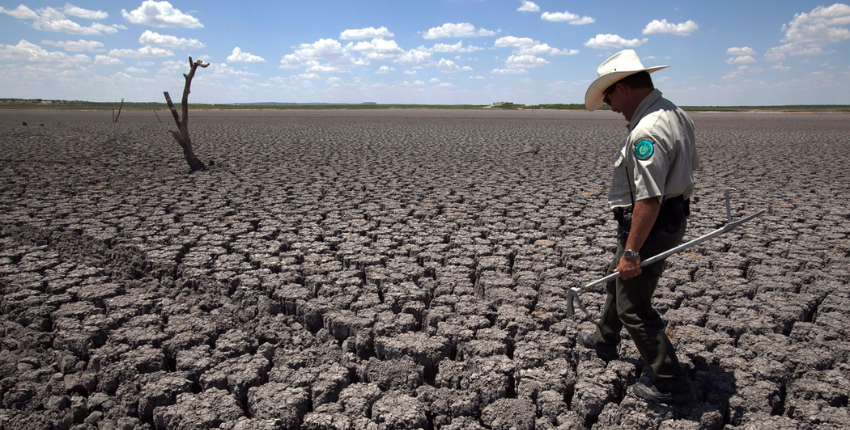
Texas faces mounting pressure on its water supplies in 2026. The state’s population and economic activity continue to grow, but the water available to serve that growth is not keeping pace.
It is projected that the total existing water supply will shrink from about 16.8 million acre-feet in 2020 to roughly 13.8 million acre-feet by 2070, even as demand continues to rise. An acre-foot is about 325,851 gallons, meaning billions of gallons per year will no longer be readily available in future decades.
Water Supply Pressures Across Texas
Rapid Population Growth and Escalating Water Demand
The steep rise in water demand in Texas is tied directly to more people, more businesses, and more water-intensive industries. The Texas Water Development Board projects that the state could grow from almost 30 million residents in 2020 to more than 51 million by 2070, putting greater strain on water infrastructure and supply.
The pace of urban growth in cities like Austin, Dallas-Fort Worth, and San Antonio is accelerating the need for new systems to serve residents and businesses.
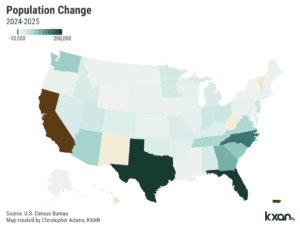
Figures from 2024 show Houston remains the largest city in Texas by far, with almost 2.4 million residents
As the state’s population increases and urbanizes, municipal water use rises alongside growth in agriculture, manufacturing, and power production. Projections in the State Water Plan show that total water demand will increase significantly over the coming decades, even with conservation measures taken into account.
Industrial Growth, Agricultural Demand, and Infrastructure Inefficiencies Driving Water Stress
With population growth comes new industrial demands that heavily influence water forecasts. For example, the rapid construction of data centers across Texas, which require large volumes of water for cooling systems, adds to municipal and industrial demand.
Likewise, agriculture continues to be a major water user, particularly in rural areas, where irrigation systems draw from both surface and groundwater.
Infrastructure loss and inefficiency add to the problem. In 2025 legislation, state officials highlighted that Texas loses about 88 billion gallons of water annually simply due to aging and broken pipes. That loss alone could meet the residential needs of hundreds of thousands of households, underscoring the dual need for infrastructure investment and demand management.
How Climate Change Plays a Part in Texas Water Issues
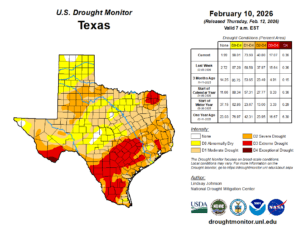
Climate variability and prolonged drought conditions are placing increasing strain on Texas water resources. Recent data highlights both the environmental and economic risks associated with a less diversified water supply portfolio.
- Medina Lake (Texas Hill Country) fell to 2.1% capacity in 2025, reaching levels where virtually no water flows downstream without sustained rainfall.
- Lake Travis (Central Texas) dropped roughly 636 ft above mean sea level during the 2025 drought, more than 40 ft below full capacity, underscoring the strain on regional water supplies.
- The Barton Springs–Edwards Aquifer Conservation District declared an exceptional drought, triggering mandatory reductions of 30–100% in groundwater pumping across Central Texas.
- Drought conditions extended across West Texas, where major reservoirs, including E.V. Spence and O.H. Ivie, recorded storage levels below 50% capacity during parts of 2025.
Economic Impact of Drought in Texas
The impact of these pressures is not just environmental but economic. A Texas 2036 assessment estimates that without a diversified supply portfolio, annual economic losses from prolonged drought could reach $160 billion by 2030, threatening jobs and investment across Texas.
Water Reuse as a Strategic Solution
Much of today’s water conversation in Texas focuses on increasing supply through new wholesale sources, irrigation limits, native landscaping, and infrastructure upgrades. While these efforts are critical, water challenges are not just about developing new supplies. It is also about how much fully treated drinking water is currently being used for purposes that do not require potable standards.
Water reuse is a practical and emerging strategy that involves treating and repurposing wastewater for non-drinking uses such as irrigation, cooling systems, industrial processes, and toilet flushing.
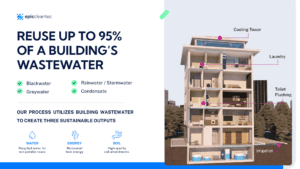
Onsite Water Reuse Systems (OWRS) offer a long-term planning strategy that complements supply-side investments. By treating and reusing water directly at the building level, OWRS reduces overall demand on centralized potable systems. Every gallon reused onsite is a gallon that does not need to be purchased wholesale, treated to drinking water standards, pumped through aging infrastructure, or conveyed across long distances.
In this way, reuse is not just an alternative supply. It is a demand-reduction strategy embedded directly into development, helping cities stretch existing resources further while building resilience into future growth.
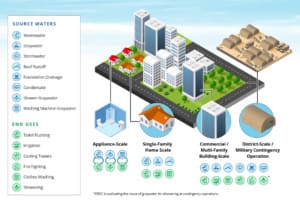
Source: University of Southern California ReWater Center
The scales, source waters, and end uses of OWR.
Across Texas, cities and utilities are increasingly incorporating reuse into long-range water plans alongside conservation and other supply diversification strategies. One of the most forward-looking examples of water reuse implementation in Texas is Austin’s GoPurple program. Established by Austin Water as part of the city’s broader Water Forward 100-Year Plan, GoPurple is designed to expand the use of reclaimed water for non-potable purposes and integrate reuse into new and existing developments.
The initiative was formally approved by the Austin City Council to help conserve water and mitigate the impacts of drought while executing long-term planning priorities. The program includes financial incentives, code updates, and rebates to support builders and property owners as they make these changes.
The Future of Water Sustainability
At Epic Cleantec, we believe that sustainable water management means embracing a suite of solutions that support long-term resilience. Our work helps developers and property owners design, permit, and implement onsite reuse systems that align with local policy efforts, improve water savings, and contribute to overall sustainability goals.
Texas is facing challenging water dynamics. But with innovation, policy support, and strategic investment in reuse and infrastructure, the state can lead in building a smarter, more resilient water future. Epic Cleantec is proud to support and partner with communities that are ready to embrace that future and redefine how water is valued and used.