New year, same water challenges

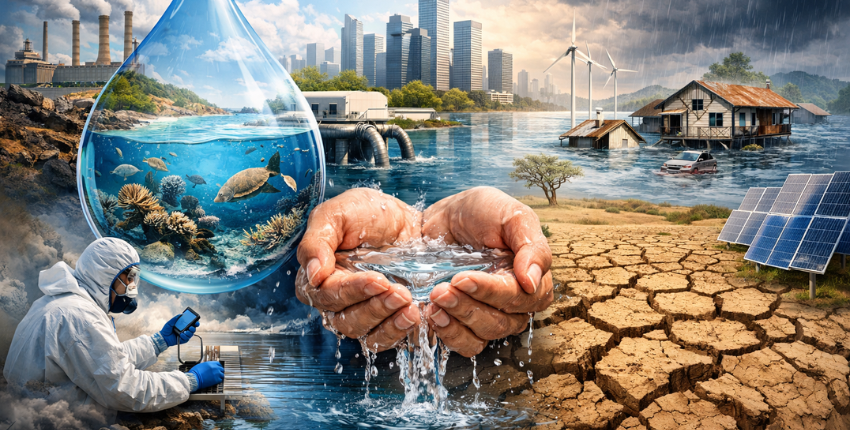
As we embrace the new year, it’s tempting to believe that the hardest water challenges are behind us. A few wet winters, improved reservoir levels, or headlines declaring an end to drought can make it feel like progress has been made. In reality, the water story heading into 2026 tells a more complicated and more urgent truth: water challenges aren’t disappearing; they are evolving.
Across the United States, communities are navigating a new normal defined by unpredictability, aging systems, and growing demand. Even when conditions temporarily improve, the underlying stresses on our water infrastructure persist.
An Era of Water Unpredictability
One of the biggest shifts shaping today’s water landscape is unpredictability. Instead of long, slow-moving droughts or consistent seasonal patterns, many regions are experiencing dramatic swings. A recent analysis found that nearly 30 million Americans reside in regions with limited water availability, underscoring that water stress is no longer isolated to a handful of drought-prone states.
In the West, warmer winters increasingly turn snowfall into rain, reducing natural snowpack storage that communities depend on through dry months. Climate change is already shrinking mountain snowpack across the Western U.S. as more precipitation falls as rain rather than snow and melts earlier in the season, diminishing the stored water that would normally feed rivers later in the year.
In other regions, extreme rainfall overwhelms aging systems, causing flooding and water quality issues without meaningfully increasing long-term supply. In December 2025, Western Washington experienced historic flooding from a series of powerful atmospheric rivers causing tens of thousands of residents to evacuate.
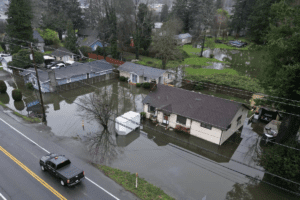
An atmospheric river swept through Western Washington, flooding homes in the city of North Bend on Dec. 11. (Source: The Seattle Times)
Aging Infrastructure
Much of the nation’s water infrastructure was built decades ago. Leaks, main breaks, and system failures are becoming more common, wasting billions of gallons of treated water each year.
Recent crises have made these vulnerabilities impossible to ignore. In cities like Jackson, Mississippi, years of underinvestment led to repeated system failures, boil-water notices, and widespread service disruptions. Similar issues have surfaced across the Midwest in communities like Cahokia Heights and across the East Coast, where aging pipes and sewer systems struggle to handle everyday use and extreme weather events.
In Alabama’s Black Belt, aging and inadequate wastewater systems have left some yards flooded with raw sewage, causing long-term public health risks. In parts of West Virginia, residents rely on polluted streams for basic needs, a consequence of insufficient infrastructure investment.
Replacing or upgrading this infrastructure is expensive, disruptive, and time-consuming, but delaying action only increases long-term costs. Water systems designed for the past are struggling to meet the demands of today, let alone the realities of tomorrow.
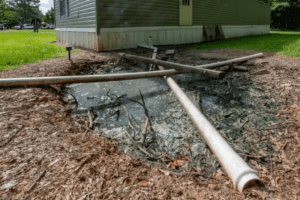
Sewage collecting in crudely dug trenches. Failing septic tanks that send waste bubbling into backyards. These are some of the common sights across Alabama’s Black Belt (Source: U.S. Department of Agriculture)
Water Quality Challenges
While water supply challenges often dominate public discussion, water quality issues continue to pose serious risks to public health, ecosystems, and infrastructure across the United States.
Communities are facing increasing threats from contaminants like PFAS, often called “forever chemicals,” which have been found in groundwater, surface water, and drinking water systems nationwide. A recent U.S. Geological Survey study estimates that at least 45% of the nation’s tap water contains one or more types of PFAS. With more than 12,000 known PFAS compounds and limited detection capabilities.
A long-standing water quality concern involves combined sewer overflows. Cities such as New York, Chicago, and Philadelphia still rely on sewer systems that carry both stormwater and wastewater. During heavy rain events, these systems can overflow and discharge untreated sewage into rivers and coastal waters. EPA data shows that roughly 700 U.S. communities experience these overflows, which remain a major public health and water pollution issue.
At the same time, lead service lines remain a pressing concern. Flint, Michigan, remains a stark reminder of how governance failures and cost-driven decisions can devastate communities. A water supply switch intended to save money exposed thousands of residents to lead-contaminated drinking water, with impacts that persist to this day.
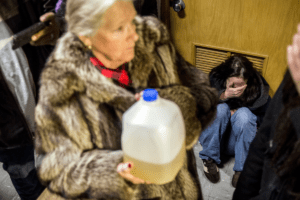
Flint resident drops to the floor in tears and a resident holds a jug of contaminated water at the city council chamber. (Source: The Guardian)
The Human Side of the Water Crisis
Water is often described as a basic human right, yet for millions of Americans, that promise remains unfulfilled. More than 2 million people in the United States live without running water or basic indoor plumbing, and many more lack access to safe sanitation altogether.
Housing insecurity further deepens this crisis. Over 600,000 people across the U.S. experience homelessness, many without dependable access to clean water, restrooms, or sanitation services. At the same time, water is becoming increasingly unaffordable for those who do have access to it. As utilities work to upgrade aging infrastructure, rate increases are becoming more common, with some households seeing water bills rise nearly 60% from 2015 to 2025.
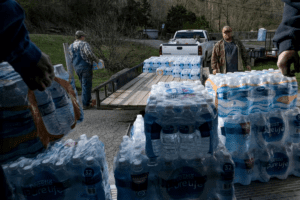
In the Appalachian region, people pick up donated water due to fear of safe tap water. (Source: The Washington Post)
In parts of the Southwest, the burden is especially visible. Families on the Navajo Nation routinely drive hours to haul barrels of water just to meet daily needs. Along the Texas–Mexico border, some communities face a different but equally urgent risk. Without reliable running water, even basic fire protection can be compromised, putting entire neighborhoods in danger.
These local challenges are connected to broader regional strain. The Colorado River Basin serves as a critical water source for tens of millions of people and has been stretched beyond its limits for decades. Long-term studies show that average river flows have declined nearly 20% since 2000, even as demand continues to grow.
Together, these realities reveal a critical truth. Water crises are often the result of governance failures, aging infrastructure, and decades of underinvestment. And they impact real people, in real communities, every single day.
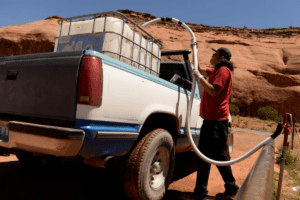
Navajo Nation resident waited in line for two hours to fill his water tank in Oljato-Monument Valley, San Juan County (Source: The Salt Lake Tribune)
Water Reuse as the New Standard
Despite these challenges, the future of water doesn’t have to be defined by scarcity and uncertainty. Across the globe, innovative water technologies are proving that we can do more with the water we already have.
By capturing, treating, and reusing water locally, communities can reduce strain on freshwater supplies, improve drought resilience, and create systems that are far less vulnerable to climate variability. Reuse offers consistency in a world where traditional sources are increasingly unpredictable.
What was once seen as a niche solution is becoming the new standard. The question is no longer whether we should invest in water reuse, but how quickly we can scale it.
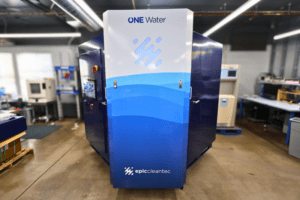
Epic Cleantec’s OneWaterTM system captures, treats, and reuses building wastewater onsite—turning what was once wasted into a valuable resource.
Want to learn more about how onsite water reuse systems can transform your project? Read more here.